
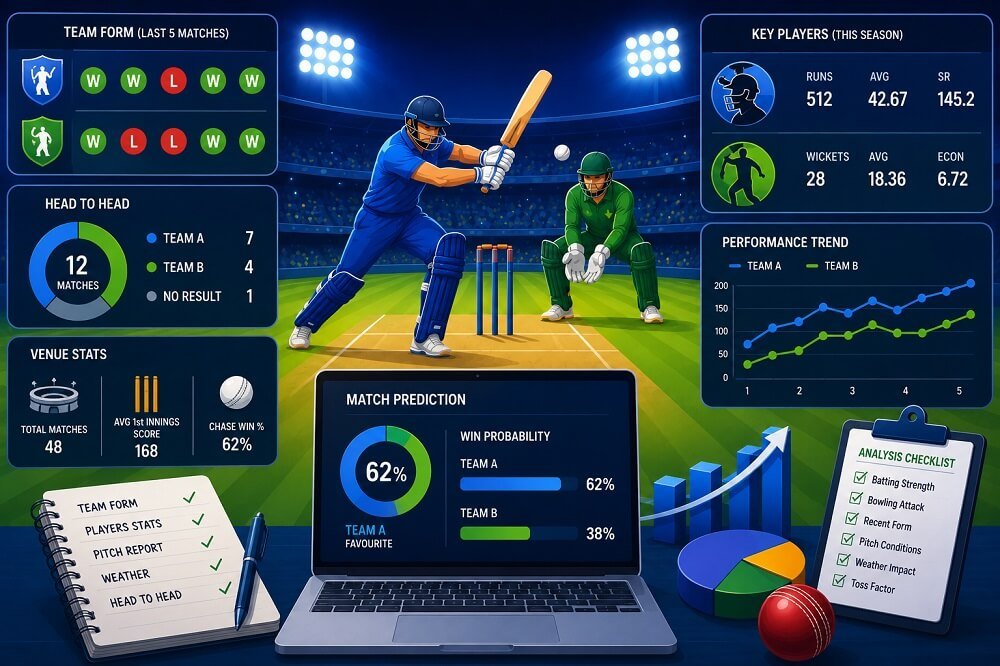
What Is a Cricket Betting Prediction?
A cricket betting prediction is an analysis of a match using available information such as team form, player performance, venue history, weather forecasts, and pitch conditions. It is designed to help people understand the factors that may influence a game.
A prediction is not a guarantee of the final result. Cricket remains unpredictable, and unexpected performances, injuries, or changing conditions can alter any match.
Why Match Analysis Matters
Experienced cricket followers rarely rely on a single statistic. Instead, they combine multiple factors to build a balanced view of the game.
Important areas include:
- Recent team form
- Batting depth
- Bowling strength
- Player fitness
- Pitch report
- Weather forecast
- Venue history
- Toss result
- Match format
The more complete your research, the better your understanding of the match context.
Analyze Team Form
Team form reflects how a side has performed over recent matches.
Consider:
- Wins and losses
- Margin of victory
- Quality of opposition
- Home vs away record
- Batting consistency
- Bowling performance
Recent form often provides more relevant insights than results from several years ago.
Evaluate Player Performance
Individual players can have a major influence on a match.
Batters
Review:
- Runs scored
- Batting average
- Strike rate
- Recent scores
- Performance against similar bowling attacks
Bowlers
Review:
- Wickets taken
- Economy rate
- Bowling average
- Bowling strike rate
- Performance in the current format
Current form should be considered alongside long-term performance.
Compare Head-to-Head Records
Head-to-head records can provide historical context, but they should not be used in isolation.
Ask questions such as:
- Were the previous matches played in similar conditions?
- Are the squads largely unchanged?
- Were key players available?
Historical records are one piece of the puzzle, not the entire picture.
Read the Pitch Report
Pitch conditions often influence how a match develops.
Common pitch types include:
Green Pitch
May assist seam bowlers early.
Flat Pitch
Usually provides consistent bounce and can support higher scores.
Dry Pitch
May offer more assistance to spin bowlers as the game progresses.
Worn Surface
Can become more challenging for batters during longer matches.
Pitch reports should always be considered alongside team composition.
Check the Weather Forecast
Weather can affect:
- Rain interruptions
- Swing bowling
- Dew in evening matches
- Humidity
- Wind conditions
Outdoor cricket is highly dependent on changing weather, especially in limited-overs formats.
Venue Statistics
Every cricket ground has its own characteristics.
Useful venue information includes:
- Average first innings score
- Chasing success rate
- Pace vs spin performance
- Boundary dimensions
- Historical scoring trends
Venue data provides additional context but cannot predict the exact outcome of a match.
Does the Toss Matter?
The toss can influence tactics, especially in shorter formats.
Teams may choose to:
- Bat first
- Bowl first
The decision often depends on:
- Pitch conditions
- Dew forecast
- Weather
- Team strengths
However, winning the toss does not guarantee winning the match.
Understanding Win Probability
Some live score platforms display win probability percentages.
These estimates are based on factors such as:
- Current score
- Wickets remaining
- Overs left
- Required run rate
- Historical match data
Win probability is a statistical estimate, not a certainty.
Live Match Analysis
During a live match, additional information becomes available.
Watch:
- Current run rate
- Required run rate
- Batting partnerships
- Bowling changes
- Field placements
- Match momentum
These factors may influence how the game develops, but unexpected events can always occur.
Common Prediction Mistakes
Avoid these common errors:
- Following social media predictions without research
- Betting based only on favorite teams
- Ignoring injuries or team news
- Overreacting to one recent match
- Assuming odds guarantee results
- Ignoring weather or pitch reports
- Chasing losses after unsuccessful bets
Responsible Betting Practices
If you choose to bet:
- Set a fixed entertainment budget.
- Never bet with money needed for essential expenses.
- Avoid chasing losses.
- Research before making decisions.
- Take regular breaks.
- Bet only where it is legal and if you meet the required age limits.
Remember that no prediction model, expert, or betting strategy can guarantee winning outcomes.
Key Takeaways
- Cricket betting predictions are based on research, not certainty.
- Analyze team form, player statistics, venue history, weather, and pitch reports together.
- Consider the toss and match format when reviewing a game.
- Use live information carefully during in-play betting.
- Bet responsibly and within your personal limits.
Frequently Asked Questions
What is a cricket betting prediction?
A cricket betting prediction is an analysis of a match using statistics and available information such as team form, player performance, venue history, and weather conditions.
Can cricket betting predictions guarantee results?
No. Predictions provide informed analysis but cannot guarantee the outcome of a cricket match.
Which statistics are most useful?
Recent team form, player performance, pitch reports, weather forecasts, venue records, and confirmed playing XIs are among the most valuable factors.
Why does the pitch report matter?
Pitch conditions can influence batting and bowling performance, making them an important part of match analysis.
Is live match analysis better than pre-match analysis?
Live analysis includes real-time information, while pre-match analysis focuses on historical and pre-game factors. Both can provide useful context but neither guarantees results.