
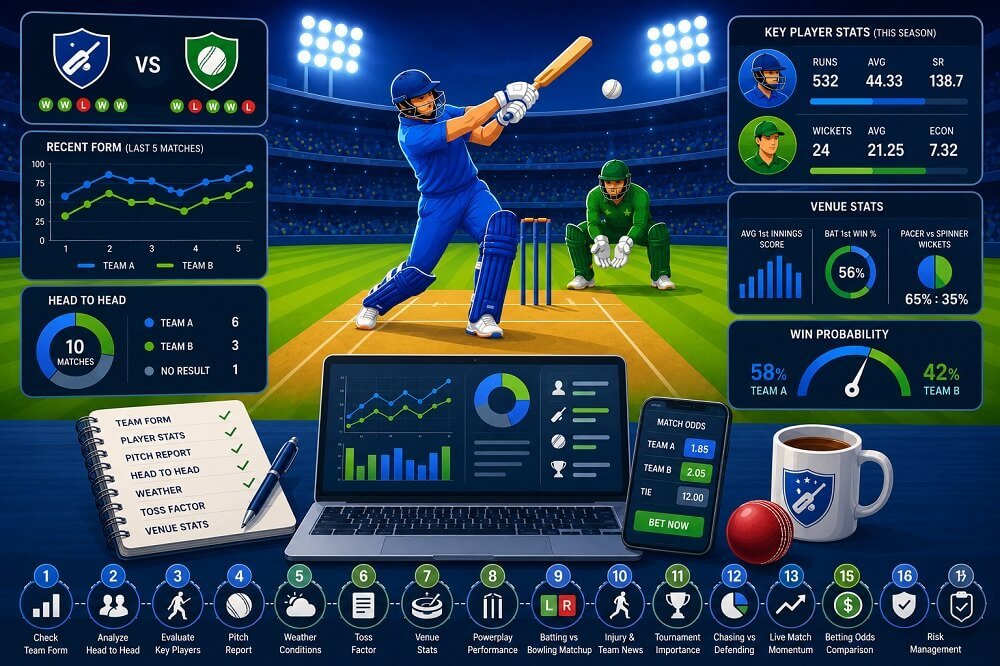
Cricket betting is not simply about choosing the team you support. A more informed approach involves understanding team form, player performances, pitch conditions, weather, match format, statistics, and the latest team news.
For beginners, all of this information can seem overwhelming. The good news is that you do not need complicated mathematical models to start analyzing cricket matches. By following a consistent process and comparing relevant information, you can make more disciplined betting decisions.
In this guide, we cover 15 free cricket betting tips for 2026 to help beginners understand how to analyze matches before placing a wager, including useful insights for those exploring gold 365 cricket and online cricket betting.
What Are Free Cricket Betting Tips?
Free cricket betting tips are publicly available insights or analysis designed to help bettors evaluate a cricket match.
They can include information about:
- Team form
- Head-to-head records
- Player statistics
- Pitch conditions
- Weather
- Toss results
- Batting and bowling performance
- Injuries and team selection
- Recent results
- Match format
- Home and away performance
- Betting odds
The purpose is not to predict every match with certainty. Instead, good analysis helps you understand the factors that could influence the outcome.
15 Free Cricket Betting Tips for 2026
1. Study Recent Team Form
One of the simplest places to start is recent team performance.
Look at the team’s latest matches and consider:
- Wins and losses
- Quality of opponents
- Runs scored
- Wickets taken
- Batting consistency
- Bowling performance
- Performance in similar conditions
However, do not assume that a team winning several recent matches will automatically win the next one.
The quality of opposition and match conditions also matter.
2. Consider the Cricket Format
A common mistake among beginners is treating Test cricket, ODIs, and T20 matches in the same way.
Each format has different characteristics.
Test Cricket
Important factors can include:
- Batting depth
- Bowling workload
- Pitch deterioration
- Session-by-session momentum
- Ability to take 20 wickets
ODI Cricket
Consider:
- Powerplay performance
- Middle-over batting
- Death-over bowling
- Batting depth
- Run-rate management
T20 Cricket
T20 matches can be particularly volatile.
Important factors may include:
- Power-hitting
- Strike rates
- Death bowling
- Powerplay wickets
- Six-hitting ability
- All-rounders
- Matchups between batters and bowlers
Always analyze a team within the context of the format being played.
3. Check Pitch Conditions
The pitch can have a major influence on a cricket match.
Some surfaces may favor batting, while others can provide assistance to fast bowlers or spinners.
Before analyzing a match, look for reliable information about:
- Pitch history
- Average first-innings score
- Spin assistance
- Pace and bounce
- Dew
- Recent matches at the venue
A pitch that has historically produced high scores may be more relevant to an analysis than a team’s overall scoring average.
4. Check the Weather Forecast
Weather can affect cricket in several ways.
Rain may reduce the number of overs, while humidity, wind, and dew can influence bowling and batting conditions.
For limited-overs cricket, a shortened match can significantly change the tactical situation.
For Test matches, weather interruptions can also affect the number of available playing sessions.
Always use a reliable and current weather source rather than relying on an old forecast.
5. Analyze Player Form
Team statistics are useful, but individual player form can also provide important context.
For batters, consider:
- Recent runs
- Average
- Strike rate
- Recent dismissals
- Performance against particular bowling styles
For bowlers, consider:
- Recent wickets
- Economy rate
- Bowling average
- Overs bowled
- Performance against specific batters
Recent form should be considered alongside long-term performance rather than treated as a guarantee of future results.
6. Check Team News and Playing XI
Team selection can change the outlook of a match.
Before placing a bet, check for:
- Injuries
- Rested players
- Suspensions
- Late replacements
- Captain changes
- Changes to the bowling attack
- Changes to the opening partnership
A star player missing from the confirmed XI may affect a team’s strength considerably.
For this reason, it can be useful to check the confirmed playing XI before making a final decision.
7. Understand Head-to-Head Statistics
Head-to-head records can provide useful historical context.
For example, you might compare how two teams have performed against each other over recent matches.
But avoid relying exclusively on historical records.
Teams change. Players retire or transfer. Coaches change. Venues change. The format may also be different.
Use head-to-head information as one part of your analysis rather than the deciding factor.
8. Look at Home and Away Performance
Some teams perform differently depending on where they play.
A team may be particularly strong at home because its players understand local conditions.
When analyzing a match, compare:
- Home record
- Away record
- Venue-specific performance
- Performance against similar opponents
This can provide additional context that overall win-loss records may not show.
9. Analyze Batting Depth
A team’s top three batters may be excellent, but what happens if two early wickets fall?
Batting depth can be particularly important in T20 and ODI cricket.
Look at:
- Opening partnership
- Middle-order strength
- All-rounders
- Lower-order batting
- Finishing ability
A deep batting lineup can provide additional resilience when a team loses early wickets.
10. Analyze Bowling Depth
The same principle applies to bowling.
A team may have one outstanding fast bowler, but a complete attack usually needs several reliable options.
Consider:
- New-ball bowlers
- Middle-over spinners
- Death bowlers
- All-rounders
- Bowling variety
- Recent wicket-taking performance
In T20 cricket especially, the ability to bowl effectively during the final overs can be important.
11. Pay Attention to the Toss
The toss can influence strategy, particularly at certain venues.
Captains may choose to bat or bowl first depending on:
- Pitch conditions
- Weather
- Dew
- Historical venue trends
- Match format
However, the toss should not automatically determine your betting decision.
Consider the toss together with the rest of your analysis.
12. Compare Odds Before Betting
If you are considering a particular market, compare the available odds rather than automatically accepting the first price you see.
Odds represent the market’s current price for an outcome, but they do not guarantee that the outcome will happen.
For example, decimal odds of 2.00 imply a simple gross return of 2 times the stake if the bet wins, including the original stake. Actual betting markets also incorporate the operator’s margin.
Understanding odds helps you evaluate what you are actually being offered.
13. Don’t Ignore Live Match Information
Live cricket can provide information that was unavailable before the match.
During an innings, consider:
- Current score
- Wickets lost
- Overs remaining
- Current run rate
- Required run rate
- Batters at the crease
- Bowlers remaining
- Partnership size
- Match situation
Live betting markets can change quickly after a boundary, wicket, injury, or other major event.
If you are new to live betting, avoid rushing into a wager simply because the odds have changed.
14. Avoid Betting With Your Emotions
Supporting a cricket team and betting on that team are two different things.
Fans may naturally believe their favorite team will win even when the available evidence suggests a more balanced situation.
Try to separate:
“I want this team to win”
from:
“The available information supports this outcome.”
Emotional betting can lead to impulsive decisions and unnecessary losses.
15. Keep a Betting Record
One of the most useful free tools is a simple betting record.
Record information such as:
- Date
- Match
- Market
- Selection
- Odds
- Stake
- Result
- Reason for the bet
After several weeks or months, you can review your decisions and identify patterns.
For example, you might discover that you perform better when analyzing T20 matches than Test matches, or that certain types of markets lead you to make impulsive decisions.
A record encourages discipline and helps you evaluate your decisions objectively.
How to Analyze a Cricket Match Step by Step
Instead of looking at dozens of statistics without a plan, beginners can use a simple checklist.
Step 1: Identify the Match
Check the teams, competition, venue, and format.
Step 2: Review Recent Form
Look at recent performances and the quality of the opposition.
Step 3: Check Team News
Look for injuries, availability, and expected or confirmed playing XIs.
Step 4: Study Conditions
Review the pitch, venue statistics, and weather.
Step 5: Compare Batting and Bowling
Assess the strengths and weaknesses of both teams.
Step 6: Check Relevant Statistics
Use player and team statistics that relate specifically to the format and conditions.
Step 7: Review the Market
Understand what market you are considering and check the current odds.
Step 8: Set Your Budget
Decide your maximum stake before placing any wager.
Step 9: Make a Decision—or Don’t
If the available information is unclear, there is nothing wrong with skipping the bet.
Free Cricket Betting Tips vs Paid Prediction Services
Many websites and social media accounts promote paid cricket predictions.
Paid services are not automatically better than free analysis.
Before paying for a prediction service, ask:
- Is its historical performance independently verified?
- Are losing predictions included?
- Are results presented transparently?
- Are claims of guaranteed wins being made?
- Are the terms and pricing clear?
Be particularly cautious about anyone promising guaranteed cricket betting profits.
There is no legitimate method that can eliminate the uncertainty of sporting events.
Common Cricket Betting Mistakes
Betting on Every Match
You do not need to bet on every cricket match.
Sometimes there simply isn’t enough information to make a decision you are comfortable with.
Chasing Losses
Increasing your stake after losing in an attempt to recover money can create larger losses.
Take a break instead.
Following Random Social Media Tips
A prediction without supporting analysis provides limited value.
Look for reasoning, statistics, and transparent information rather than simply following a selection.
Ignoring Odds
Picking a likely winner is not the same as identifying a potentially worthwhile betting opportunity.
The odds matter.
Using Money You Cannot Afford to Lose
Never use money required for rent, food, bills, debt payments, or other essential expenses.
Responsible Cricket Betting
Betting should be treated as entertainment rather than a way to make regular income.
Consider setting:
- A fixed spending limit
- A time limit
- Deposit limits where available
- Betting breaks
- Self-exclusion controls where necessary
Never borrow money to gamble and never chase losses.
If gambling is becoming difficult to control or is affecting your finances, relationships, work, or wellbeing, stop gambling and seek appropriate professional or local support.
Final Thoughts
Good cricket betting analysis is about more than choosing a winner. With cricket bet live 365, bettors can focus on understanding team form, player performance, pitch conditions, match statistics, and other factors before making an informed betting decision.
The strongest approach is to combine relevant information, understand the match format, evaluate current conditions, compare odds, and maintain disciplined bankroll habits.
These 15 free cricket betting tips for 2026 provide a starting point for beginners who want to understand how cricket matches can be analyzed.
Remember that even detailed research cannot remove the risk involved in sports betting. There are no guaranteed predictions, and sometimes the smartest decision is not to place a bet at all.
Frequently Asked Questions
What are the best free cricket betting tips?
There is no single best tip that works for every match. A more reliable approach is to analyze team form, player performance, pitch conditions, weather, team selection, match format, and relevant statistics together.
Can cricket betting tips guarantee a win?
No. Cricket matches contain uncertainty, and no prediction can guarantee a winning bet.
Are free cricket betting tips useful?
They can be useful when they provide transparent reasoning and relevant statistics. However, bettors should conduct their own research rather than blindly following predictions.
What should beginners analyze before betting on cricket?
Start with the match format, recent team form, player availability, pitch conditions, weather, batting and bowling strength, and current odds.
Should I bet before or after the toss?
There is no universally correct answer. The toss can provide additional information, but it should be considered alongside team strength, conditions, and the market rather than treated as a guaranteed advantage.
Are live cricket betting tips different?
Yes. Live betting requires consideration of real-time factors such as the score, wickets, overs remaining, run rate, required run rate, and current players at the crease.
How much should I bet on cricket?
Only use money you can afford to lose. Set a personal budget before betting and do not increase your stakes to recover losses.